Buying a fence
Three quotes, three numbers, and no way to compare them
Most fence estimates are one page and mostly a price. Two of them can differ by forty percent and neither one tells you why, because neither one says what it is actually buying. Here are ten questions that make them comparable. Ask us the same ones.
01 / The problem
A fence is mostly buried
When the job is finished, the part of the fence you can inspect is the pickets. Everything that decides how long it lasts is either underground, behind the pickets, or too small to see from the patio: the post, the footing, the fasteners, and the frame inside the gate.
That is not a conspiracy, it is just how the thing is built. But it does mean a finished fence looks about the same whether it was built well or badly, and it stays looking the same for two or three years. By the time the difference shows up, the crew that built it has been gone a long while.
So the comparison has to happen before anybody digs, and it has to happen on paper.
02 / The ten questions
Ask all of them, of everybody
None of these are trick questions and none of them are unreasonable. Any contractor who builds this way already knows the answers.
-
01
What is the post made of, and what size?
- A complete answer
- A named material and a dimension. Galvanized steel, or 4x4 treated pine, or 4x6. If it is steel, the gauge.
- The answer to worry about
- "Pressure treated posts."
The post is the only part of a fence carrying load into the ground. Everything else is attached to it. If a quote is vague anywhere, this is the worst place for it to be vague.
-
02
How deep does the post go, and how far apart?
- A complete answer
- A number in inches and a number in feet. For example 36 inches deep at 8 feet on center.
- The answer to worry about
- Nothing at all, or "to code".
Depth and spacing are the two numbers that decide whether a fence stands up in a storm, and they are the two easiest places to save money without a customer noticing until the wind comes.
-
03
How much concrete per post, and is it crowned?
- A complete answer
- A bag count or a volume, and a yes on the crown.
- The answer to worry about
- "Set in concrete."
A footing with a flat or dished top holds water against the post. Crowning it so it sheds is a few seconds of work per hole and it is one of the clearest tells of whether somebody is in a hurry.
-
04
What are the pickets, and are they finished before or after they go up?
- A complete answer
- Species, grade, thickness, and whether they arrive pre-stained on all faces or get sealed on site.
- The answer to worry about
- "Cedar tone pickets."
A picket stained on site is stained on the faces you can reach. The back of the picket, the edges and the parts behind the rail are the parts that go first.
-
05
What is the gate frame built from?
- A complete answer
- Welded steel, or a named wood frame with a diagonal brace called out and a direction given for the brace.
- The answer to worry about
- The gate is not mentioned separately at all.
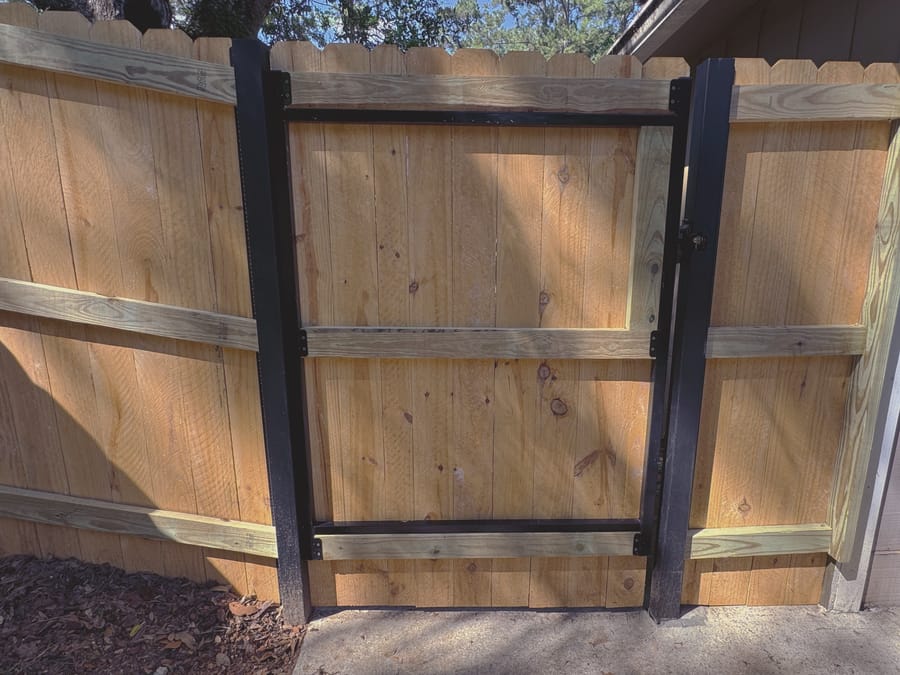
The gate is the only moving part. It is the first thing to fail on nearly every fence, and on many quotes it is priced as if it were another eight feet of fence.
-
06
What are the fasteners?
- A complete answer
- A coating and a type. Hot dipped galvanized ring shank, stainless, or a named screw.
- The answer to worry about
- No mention.
Electro-galvanized fasteners in treated lumber in a wet climate will bleed rust down the face of a new fence inside a couple of seasons. It is a small line item and a very visible failure.
-
07
What happens where the ground is not level?
- A complete answer
- A stated method: racked to follow the grade, or stepped, and which one applies where.
- The answer to worry about
- Silence, which usually means the crew will decide on the day.
Racking and stepping look completely different when finished. If nobody decided in advance, you find out which one you got after it is built.
-
08
Who calls in the utility locate, and when?
- A complete answer
- A clear answer, and a note that the dig will not start before the locate clears.
- The answer to worry about
- Nothing.
The locate is free and it is required. A contractor who is casual about it is telling you something about the rest of the job.
-
09
What does the site look like when you leave?
- A complete answer
- A stated scope: spoil removed or spread, offcuts hauled, the fence line raked.
- The answer to worry about
- No mention, which usually means the spoil pile stays.
Every post hole produces a pile of dirt. Multiply that by fifty posts and it is a real question, not a nicety.
-
10
What is warranted, by whom, and for how long?
- A complete answer
- Separate answers for material and for labor, with the material warranty attributed to the manufacturer by name.
- The answer to worry about
- "Lifetime warranty" with no subject and no document.
A material warranty and a workmanship warranty are different promises from different parties. A quote that blends them into one word has told you nothing you could ever claim on.
03 / Our side of it
What we put in writing
We answer all ten before you ask, in the estimate. Materials by name, post depth and spacing, concrete per post, fastener type, gate frame construction, gate locations, and how the line handles the grade.
That is not generosity. It is the only way we can charge what we charge, because our argument is entirely about the parts of a fence you cannot see, and an argument like that is worthless unless it is written down where you can hold somebody to it.
Take this list to the other quotes first. If somebody else answers all ten and comes in under us, that is a real comparison and you should take it.
Want a quote that answers all ten?
We will come walk the line, then send a written specification you can hold next to anyone else's. No same day pricing and nothing that expires.